Here is a quiet problem that does not look like a problem at first.
The business works.
Customers are getting helped. Jobs are getting finished. People leave mostly satisfied. You are not “failing.” You may even be growing.
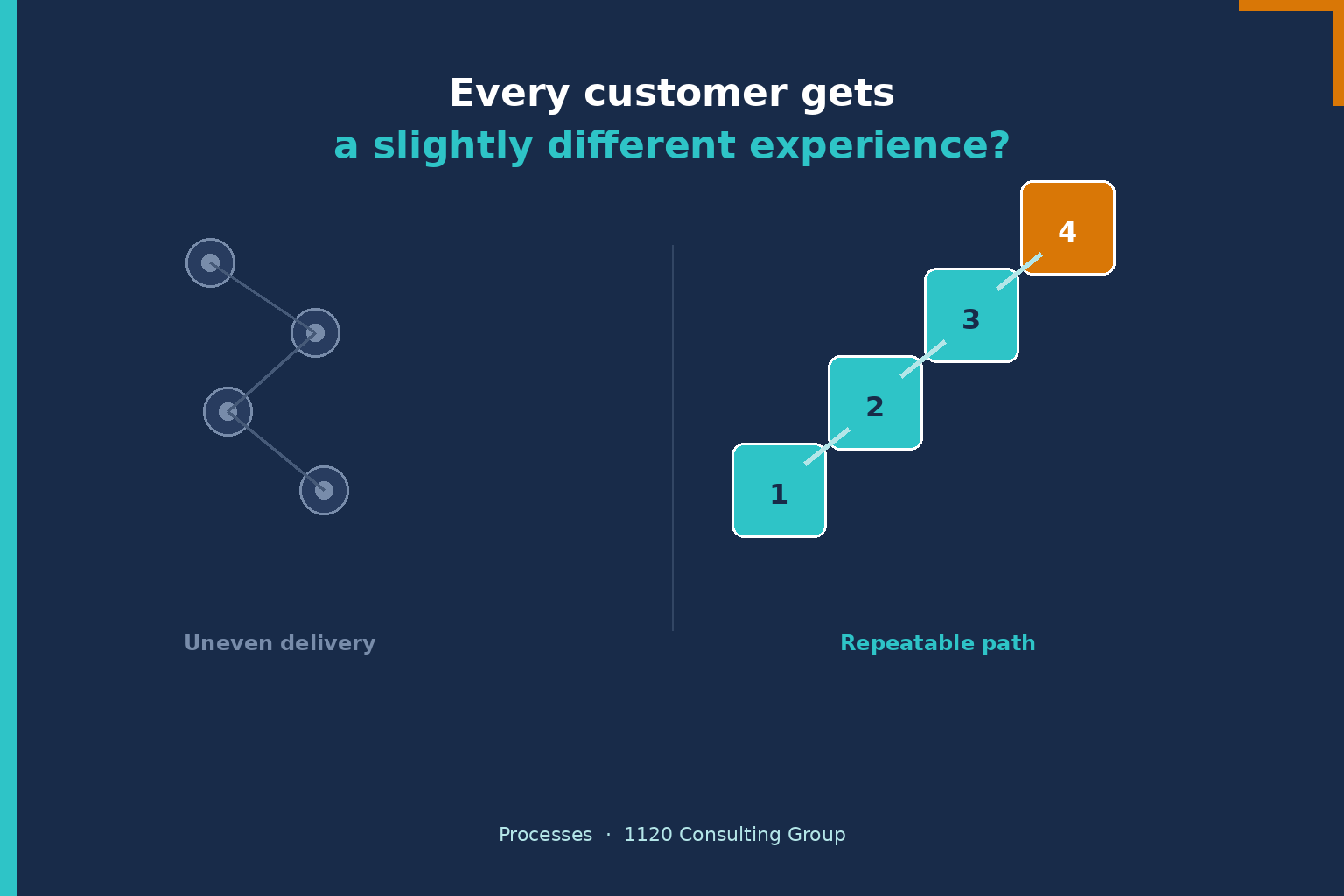
And still — if you pay attention — every customer gets a slightly different experience.
One person gets a clear follow-up. Another has to ask.
One job includes the little extras you usually remember. The next one skips them because the day got noisy.
One helper explains things one way. You explain them another. Someone else invents a third version that still “works,” just not the same way.
Nobody is trying to create chaos.
The work is simply being done from habit, memory, mood, and whatever the moment allows.
That is not a sales problem.
It is usually a Processes problem.
The business can work and still feel uneven
If customers are paying and work is getting done, it is easy to assume the system is fine.
Inconsistency rarely shows up as a crisis. It shows up as small differences that only become obvious when you look across several customers in a row.
One onboarding feels smooth. The next feels improvised. A third depends on whether you personally had time to jump in.
From the outside, each job may still look successful.
From the inside, you can feel the wobble: “We do this… usually. Unless we don’t.”
That wobble is expensive in a quiet way. Customers compare experiences. Helpers guess. You become the quality-control department for every variation. The business becomes harder to trust — not because people do not care, but because “how we do it here” was never clear enough to repeat.
What inconsistent delivery actually looks like
This is not about misplaced files. It is not mainly about whether something lives in your head. It is about how the work moves from start to finish.
It often looks like:
- Two customers asking the same question and getting two different answers
- One person getting a confirmation or next step — and another waiting
- Quality that depends on who handled the job
- “We usually do it this way” that changes under pressure
- Follow-up that happens when someone remembers, not because it is part of the work
- Training that sounds like, “Watch how I do it,” with no shared checkpoint for what “done well” means
A lot of side-hustles, solo shops, and small teams grow by doing good work fast. Consistency comes later — if it comes at all — and by then the original habits cannot carry the load.
Why this happens (even when everyone is trying)
Most small businesses do not start with documented processes. They start with a person who knows how to do the work.
You figure out a way that works. You repeat it until it becomes instinct. Someone else helps and learns by watching, asking, or improvising. Customers arrive through different channels, with different urgency, asking for slightly different things.
Soon the business has several “correct” ways to do the same job.
That is what happens when the process lives in people instead of in a shared way of working.
At 1120 Consulting Group, we look at everyday structure through the Five Ps: People, Paperwork, Processes, Platforms, and Priorities.
This friction sits first in Processes.
Processes: Is there a consistent way to do the work?
Processes are the repeatable path: what happens when a customer says yes, how a job is prepared, what gets checked before delivery, how follow-up happens, what “complete” means, and what to do when something goes sideways.
When those steps are clear, customers get a steadier experience — even on busy days. When they are not, the business still functions. It just functions differently each time.
People can care deeply and still deliver unevenly if the process is undefined. Paperwork and Platforms can be fine, and customers can still get different versions of the same service if the work path keeps shifting.
This is different from nearby problems
Scattered information (“I know I saved it somewhere”) is about finding what already exists.
Owner-dependence (“everything is in my head”) is about the business only working when one person is available.
Inconsistent customer experience is about the delivery path changing from job to job — even when people are present, tools are available, and the work eventually gets done.
Those issues can overlap. The core here is simpler:
The business works. The experience is not repeatable.
A practical way to see the pattern
Pick one common type of work — a service you sell repeatedly, or the path from “yes” to “done.” Look at the last three times you did it.
Ask:
- What was supposed to happen at each stage? Intake, confirmation, delivery, follow-up, close.
- Did those stages happen the same way each time?
- Where did the experience diverge? Timing, communication, quality checks, handoffs.
- What decided the difference? Busyness, who handled it, urgency, whether you were available.
- If someone else ran all three jobs without asking you, would customers still get roughly the same experience?
If the answer to #5 is “probably not,” you have found a Processes gap. Compare real jobs, not the idealized version in your head.
What usually helps (without the red tape)
Consistency does not mean scripting every human moment. It means deciding which parts of the experience should not depend on luck, memory, or mood.
1. Name the customer journey for one offer. Not every offer. One. From first contact to finished work to follow-up.
2. Define “done well.” What should every customer reliably get — confirmation, timeline, quality check, closing note? Choose the few standards that matter most.
3. Separate must-happen steps from judgment. Judgment can stay human. Must-happen steps need a default so busy days do not erase them.
4. Make the default visible. A short checklist or simple sequence beats a long document nobody opens.
5. Strengthen the busy-day version. If the process only works when the schedule is light, it is not the real process yet.
None of this requires enterprise software. It requires clearer defaults for the work you already do.
How to choose what to tighten first
Do not try to standardize the whole business at once.
Start where inconsistency is most visible to customers or most expensive to you: the path from “yes” to kickoff, how you confirm next steps, the quality check before delivery, follow-up after the work, or answers to common questions.
Choose the one that created the most “wait… we usually do it differently” moments in the last month. Tighten that lane. Run it the same way for the next several jobs. Then notice what improved.
One repeatable path beats a perfect operations system that never gets finished.
A clearer place to begin
If this feels uncomfortably true, you are probably looking at a business that grew on good instincts — and now needs a clearer way of doing the work.
1120 helps owners look at structure across the Five Ps — especially whether Processes are clear enough to create a steadier customer experience without draining the owner. The point is to make the good work more repeatable.
A practical place to begin is Business Discovery. It is free. No grading. No judgment. Just a clearer look at how the business is operating today, what already works, and where inconsistent delivery may be asking more from you than it should.
You do not need every workflow polished before you start.
You need a clearer picture of where the experience drifts — and one useful next step.
Because the goal is not to make every interaction identical.
The goal is a business where the important parts of the experience do not change just because the day did.
Explore more practical structure ideas in Insights, or begin with Business Discovery when you want a clearer starting point.
Leave a Reply