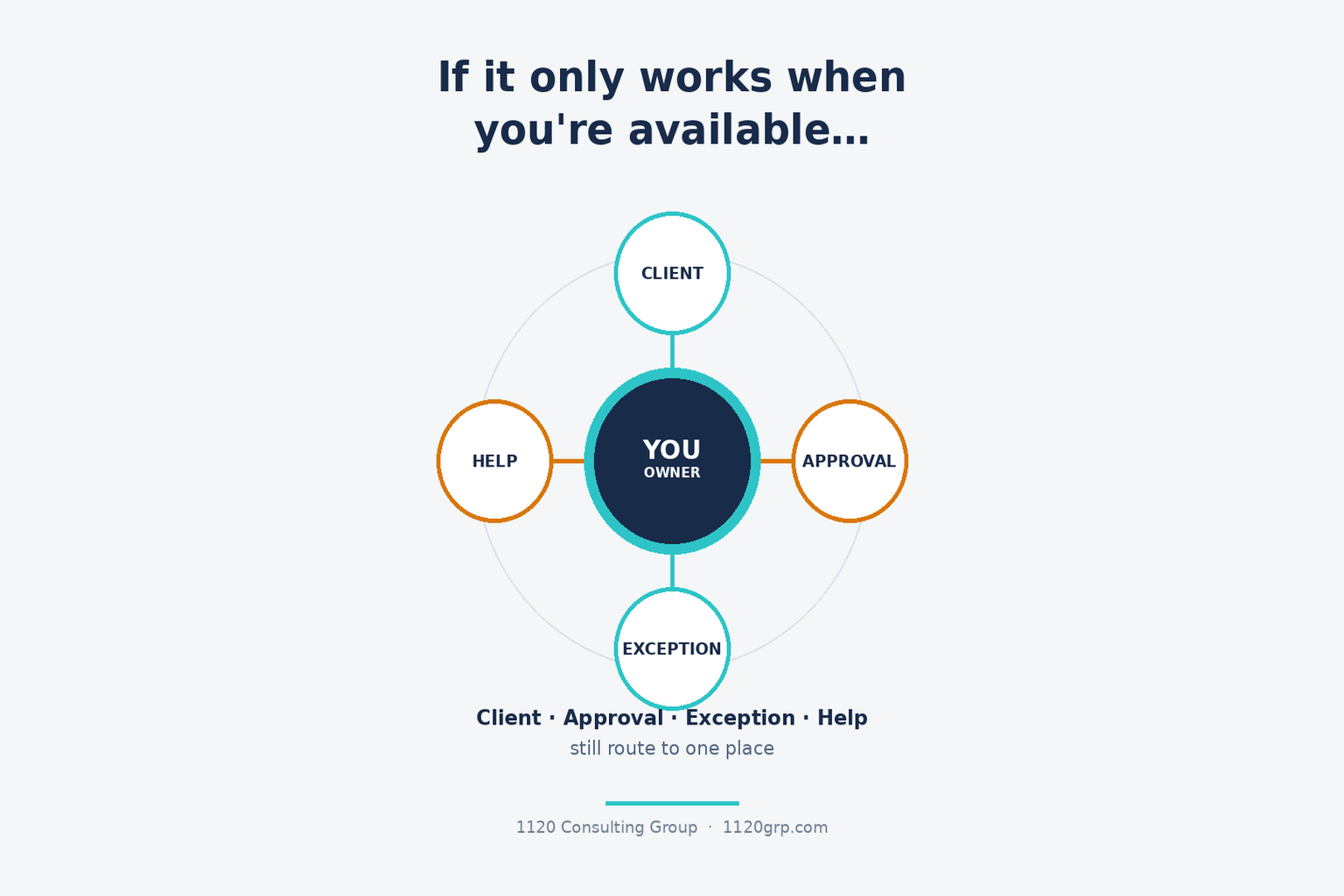
It’s 9 PM on Sunday. The house is quiet, and you finally open the laptop.
Invoices that should have gone out Thursday. A handful of emails you starred and meant to answer. A stack of receipts on the counter, or a camera roll full of them. Maybe next week’s schedule, still half in your head.
You get through most of it. You close the laptop feeling a little better and a little more tired. And next Sunday, the same list is waiting.
If that sounds familiar, here is the honest part: you’re not doing anything wrong by working hard. But Sunday night isn’t a system. It’s where the work goes when it doesn’t have anywhere else to go.
Sunday catch-up is a backlog, not discipline
It’s easy to treat Sunday night as proof that you’re on top of things. You stayed up. You handled it. Nobody waited too long.
Look at it another way, though. The same tasks show up every week. They aren’t surprises. Invoicing happens every week. Email happens every week. Receipts arrive every week. When predictable work keeps landing on Sunday night, the problem usually isn’t effort. It’s that the work never got a regular place on the weekday calendar, so it piles up until the only quiet time left.
That pile has a name: a backlog. And backlogs have a way of growing quietly. One missed Thursday becomes a full Sunday. One full Sunday becomes a habit.
The one-task move
You don’t need to rebuild your whole week to start. You need one task with one home.
1. Pick one Sunday task. Choose the one that shows up most often, or the one you dread most. Just one.
2. Give it a weekday slot. Same day, same time, every week. Put it on your calendar the way you’d put a customer appointment there. “Sometime Tuesday” isn’t a slot. “Tuesday, 8 AM” is.
3. Write the finish line. Decide what “done” looks like before you start. For invoices, it might be: “Every job finished last week has an invoice sent.” A clear finish line lets the task close without you checking it again later, and it makes it possible for someone else to do it someday.
That’s the whole move. It’s small on purpose.
A fictional example. A small cleaning company owner always sent invoices on Sunday night. She moved invoicing to Tuesday at 8 AM, before her first job, and wrote the finish line on a sticky note: “Every job from last week is invoiced.” The first two Tuesdays she ran over. By the third, it fit. Sunday night still had a few things on it, but invoices weren’t one of them.
How to tell it’s working
Give it a few weeks before you judge it. Then look for two things.
The Sunday list gets shorter, or at least stops growing. You may still have a Sunday task or two. That’s fine. What matters is that the task you moved isn’t sneaking back.
The slot holds. If your Tuesday 8 AM keeps getting bumped, that’s useful information too. Maybe the time is wrong. Maybe the task needs less than you planned, or more. Move the slot, keep the habit. The goal is a home for the work, not a perfect calendar.
Once one task holds, pick the next one. One at a time is how a week slowly gets its structure back.
When one task isn’t enough
Sometimes you move one task and the week still feels like it’s being built from scratch every Monday. That’s a sign of something bigger than one missing slot.
A few signs to watch for:
- The same questions keep coming to you, because the steps only live in your head.
- Each time a task gets done, it gets done a little differently.
- Handing something off takes longer than doing it yourself, so you keep doing it yourself.
When that’s the pattern, the work isn’t just homeless. It’s being reinvented each time. That’s a Processes question: how does the work repeat, and does it repeat the same way no matter who handles it?
A simple first step is to write down how one repeat job actually gets done today, start to finish, in one place. A plain process map, even a rough one, shows where the steps are clear and where they depend on you remembering.
A clearer place to start
If you’d like a broader look at how the work repeats in your business, alongside People, Paperwork, Platforms and Priorities, our free Business Discovery is a good place to begin. It is answers-based, and you go at your own pace. It turns those answers into a Business Snapshot and a place to begin. Anything more is separate and optional. Completing it doesn’t sign you up for anything paid.
Start your free Business Discovery
Prefer something you can do with a pen first? The free Business Assessment Checklist walks through all five areas, including Processes.
Words to know
Backlog: work that piled up because it never had a regular place in the week.
Cadence: a repeating day and time the business treats as the home for a task.
Finish line (definition of done): a clear statement of what “done” looks like, so the task can close without another check with the owner.
SOP (standard operating procedure): written steps for how a task gets done, so it’s done the same way every time, no matter who does it.
From Hustle to Structure.