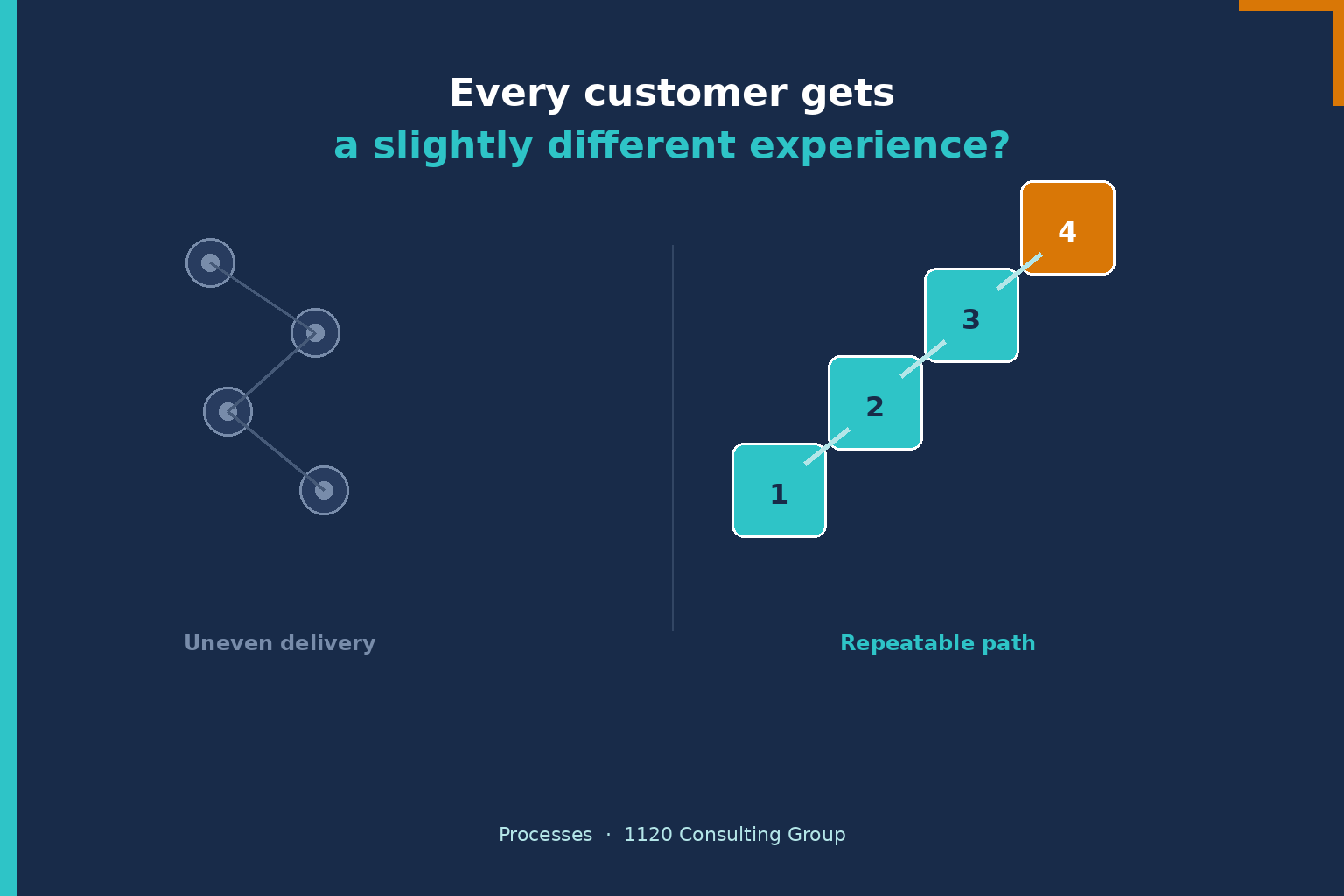
Tag: Five Ps

  • “Every Customer Gets a Slightly Different Experience”: When the Work Works — But Not the Same Way Twice

    “Every Customer Gets a Slightly Different Experience”: When the Work Works — But Not the Same Way Twice

    Here is a quiet problem that does not look like a problem at first.

    The business works.

    Customers are getting helped. Jobs are getting finished. People leave mostly satisfied. You are not “failing.” You may even be growing.

    And still — if you pay attention — every customer gets a slightly different experience.

    One person gets a clear follow-up. Another has to ask.
    One job includes the little extras you usually remember. The next one skips them because the day got noisy.
    One helper explains things one way. You explain them another. Someone else invents a third version that still “works,” just not the same way.

    Nobody is trying to create chaos.
    The work is simply being done from habit, memory, mood, and whatever the moment allows.

    That is not a sales problem.
    It is usually a Processes problem.

    The business can work and still feel uneven

    If customers are paying and work is getting done, it is easy to assume the system is fine.

    Inconsistency rarely shows up as a crisis. It shows up as small differences that only become obvious when you look across several customers in a row.

    One onboarding feels smooth. The next feels improvised. A third depends on whether you personally had time to jump in.

    From the outside, each job may still look successful.
    From the inside, you can feel the wobble: “We do this… usually. Unless we don’t.”

    That wobble is expensive in a quiet way. Customers compare experiences. Helpers guess. You become the quality-control department for every variation. The business becomes harder to trust — not because people do not care, but because “how we do it here” was never clear enough to repeat.

    What inconsistent delivery actually looks like

    This is not about misplaced files. It is not mainly about whether something lives in your head. It is about how the work moves from start to finish.

    It often looks like:

    • Two customers asking the same question and getting two different answers
    • One person getting a confirmation or next step — and another waiting
    • Quality that depends on who handled the job
    • “We usually do it this way” that changes under pressure
    • Follow-up that happens when someone remembers, not because it is part of the work
    • Training that sounds like, “Watch how I do it,” with no shared checkpoint for what “done well” means

    A lot of side-hustles, solo shops, and small teams grow by doing good work fast. Consistency comes later — if it comes at all — and by then the original habits cannot carry the load.

    Why this happens (even when everyone is trying)

    Most small businesses do not start with documented processes. They start with a person who knows how to do the work.

    You figure out a way that works. You repeat it until it becomes instinct. Someone else helps and learns by watching, asking, or improvising. Customers arrive through different channels, with different urgency, asking for slightly different things.

    Soon the business has several “correct” ways to do the same job.

    That is what happens when the process lives in people instead of in a shared way of working.

    At 1120 Consulting Group, we look at everyday structure through the Five Ps: People, Paperwork, Processes, Platforms, and Priorities.

    This friction sits first in Processes.

    Processes: Is there a consistent way to do the work?

    Processes are the repeatable path: what happens when a customer says yes, how a job is prepared, what gets checked before delivery, how follow-up happens, what “complete” means, and what to do when something goes sideways.

    When those steps are clear, customers get a steadier experience — even on busy days. When they are not, the business still functions. It just functions differently each time.

    People can care deeply and still deliver unevenly if the process is undefined. Paperwork and Platforms can be fine, and customers can still get different versions of the same service if the work path keeps shifting.

    This is different from nearby problems

    Scattered information (“I know I saved it somewhere”) is about finding what already exists.
    Owner-dependence (“everything is in my head”) is about the business only working when one person is available.
    Inconsistent customer experience is about the delivery path changing from job to job — even when people are present, tools are available, and the work eventually gets done.

    Those issues can overlap. The core here is simpler:

    The business works. The experience is not repeatable.

    A practical way to see the pattern

    Pick one common type of work — a service you sell repeatedly, or the path from “yes” to “done.” Look at the last three times you did it.

    Ask:

    1. What was supposed to happen at each stage? Intake, confirmation, delivery, follow-up, close.
    2. Did those stages happen the same way each time?
    3. Where did the experience diverge? Timing, communication, quality checks, handoffs.
    4. What decided the difference? Busyness, who handled it, urgency, whether you were available.
    5. If someone else ran all three jobs without asking you, would customers still get roughly the same experience?

    If the answer to #5 is “probably not,” you have found a Processes gap. Compare real jobs, not the idealized version in your head.

    What usually helps (without the red tape)

    Consistency does not mean scripting every human moment. It means deciding which parts of the experience should not depend on luck, memory, or mood.

    1. Name the customer journey for one offer. Not every offer. One. From first contact to finished work to follow-up.

    2. Define “done well.” What should every customer reliably get — confirmation, timeline, quality check, closing note? Choose the few standards that matter most.

    3. Separate must-happen steps from judgment. Judgment can stay human. Must-happen steps need a default so busy days do not erase them.

    4. Make the default visible. A short checklist or simple sequence beats a long document nobody opens.

    5. Strengthen the busy-day version. If the process only works when the schedule is light, it is not the real process yet.

    None of this requires enterprise software. It requires clearer defaults for the work you already do.

    How to choose what to tighten first

    Do not try to standardize the whole business at once.

    Start where inconsistency is most visible to customers or most expensive to you: the path from “yes” to kickoff, how you confirm next steps, the quality check before delivery, follow-up after the work, or answers to common questions.

    Choose the one that created the most “wait… we usually do it differently” moments in the last month. Tighten that lane. Run it the same way for the next several jobs. Then notice what improved.

    One repeatable path beats a perfect operations system that never gets finished.

    A clearer place to begin

    If this feels uncomfortably true, you are probably looking at a business that grew on good instincts — and now needs a clearer way of doing the work.

    1120 helps owners look at structure across the Five Ps — especially whether Processes are clear enough to create a steadier customer experience without draining the owner. The point is to make the good work more repeatable.

    A practical place to begin is Business Discovery. It is free. No grading. No judgment. Just a clearer look at how the business is operating today, what already works, and where inconsistent delivery may be asking more from you than it should.

    You do not need every workflow polished before you start.
    You need a clearer picture of where the experience drifts — and one useful next step.

    Because the goal is not to make every interaction identical.
    The goal is a business where the important parts of the experience do not change just because the day did.

    Explore more practical structure ideas in Insights, or begin with Business Discovery when you want a clearer starting point.


  • “I Know I Saved It Somewhere”: When Business Information Lives Everywhere Except One Place

    “I Know I Saved It Somewhere”: When Business Information Lives Everywhere Except One Place

    You know the feeling.

    A customer asks for a detail you already handled last month.
    Someone needs the latest version of a form.
    You need the password, the screenshot, the quote, the license number, the “we already decided this” note.

    And your brain says it before your mouth does:

    “I know I saved it somewhere.”

    Then the hunt begins.

    Texts. Email. Phone photos. A downloads folder. A shared drive. Three apps that each hold a piece of the same story. Maybe a sticky note. Maybe a memory that is usually reliable — until it is not.

    Nothing is “missing,” exactly.
    It is just not findable when you need it.

    It is usually a structure problem — primarily Paperwork, with Platforms showing up as all the places information can land.

    The problem is not that you never save things

    Most side-hustlers and micro-business owners save plenty.

    You forward the confirmation “so you have it.” You screenshot the approval. You text yourself a number. You drop a PDF into whatever folder was open. You answer in the app where the customer reached you. You keep the “real” version in your head because writing it down felt slower than doing it.

    At a small scale, that works. Then the business gets busier — more customers, messages, versions, and tools — and the hunt becomes part of the workday.

    You are not failing at organization. Your information habits were built for a lighter load than the business is carrying now.

    Scattered information has a quiet cost

    The cost is rarely one dramatic disaster. It is usually quieter than that.

    It looks like re-asking a customer for details you already collected, recreating a document because finding the original would take longer, sending an older version because you are unsure which file is current, paying for tools that hold overlapping pieces of the same data, or interrupting yourself mid-task to hunt and losing your place.

    Each search might only take a few minutes. Together, those minutes become a tax on every busy week. And because the information does exist somewhere, it is easy to dismiss: “I’ll find it.” You usually do. That is why the friction stays invisible — until it shapes how the business feels to run.

    Where this shows up (starting with Paperwork)

    At 1120 Consulting Group, we look at everyday structure through the Five Ps: People, Paperwork, Processes, Platforms, and Priorities.

    This particular frustration shows up first in Paperwork — and Platforms often make the scatter worse.

    Paperwork: Can you find what matters?

    Paperwork is not only binders and PDFs. It is any business information you need to reuse: customer details, agreements, forms, records, instructions, decisions, proof that something was done.

    When that information has no clear home — or too many homes — paperwork becomes a scavenger hunt.

    Platforms: Do your tools make work easier?

    Platforms are the tools around the work: email, messaging apps, cloud folders, spreadsheets, scheduling tools, payment apps, industry software, the notes app on your phone.

    A platform problem is not always “you chose the wrong software.” Sometimes it is simpler: too many places can hold the same kind of information, and none of them is clearly in charge.

    That is how you end up with a customer address in a text thread, a preference noted in email, an invoice in one app, a signed form in downloads, and the “latest” update only in your memory.

    Each piece made sense in the moment.
    Together, they make the business harder to see.

    This is different from “I should write more things down”

    It can sound related — and it is nearby — but it is not the same issue.

    “What should be written down” is about deciding which knowledge deserves a durable record.
    “I know I saved it somewhere” is about information that already exists and still cannot be retrieved without a hunt.

    You can have screenshots, emails, and files everywhere and still feel like nothing is organized. Saving is not the same as storing with intention. Volume is not the same as access.

    The goal is not more places to put things.
    The goal is fewer places you have to check.

    A practical way to see the pattern

    You do not need a full overhaul to understand what is happening. Start with one recent hunt.

    Think about the last time you said “I know I saved it somewhere.” Then answer:

    1. What were you looking for?
    2. Where did you check first? (And second? And third?)
    3. Where did it actually live?
    4. Was there more than one version?
    5. Could someone else have found it without asking you?

    If the answer to #5 is “probably not,” that is useful information. It does not mean you need corporate systems tomorrow. It means the current home for that information is still personal, informal, or split across tools that only you navigate well.

    Do this for two or three recent hunts and a pattern usually appears: texts and DMs holding customer details, unclear file names, photos stuck in a camera roll, logins buried in old email, incomplete “official” folders, or too many tools with no clear owner for the information.

    You do not have to fix all of that at once. Seeing the pattern is the first useful step.

    What usually helps (without the red tape)

    Structure here does not mean building a perfect archive. It means making important information easier to find than to recreate.

    1. Give each kind of information one primary home. Not twelve. Customer records, signed documents, active files, and reference files each need a clear landing spot. Messaging can still happen wherever customers reach you — lasting details need a home after.

    2. Separate “in motion” from “kept.” Downloads folders and camera rolls are temporary holding pens. If something matters, move it to its real home while you still remember what it is.

    3. Name things for future-you. Future-you will not remember “scan_47.” A plain name with a date or customer cue saves the next hunt.

    4. Reduce duplicate homes before adding a new tool. A fourth “organization” app often becomes another place to check. Sometimes the better move is deciding what stops living in texts, attachments, or personal devices.

    5. Make findability a business habit, not a personal talent. If only you can find it, the business does not really have it. Organize as if a future helper — or tired Friday-you — will need it quickly.

    None of this requires enterprise software. It requires clearer defaults.

    How to choose what to fix first

    When everything feels scattered, owners often try to organize everything and stall.

    Pick one high-friction category instead — usually something you hunt for weekly: active customer details, signed forms, current versions of documents you send often, business logins, or records you need for follow-up or proof.

    Choose the category behind your most recent “I know I saved it somewhere” moment. Give it one primary home. Move the active items there. Decide what “done” looks like for new items going forward.

    One clearer lane beats a perfect master system that never gets finished.

    A clearer place to begin

    If this feels uncomfortably familiar, you’re probably seeing the result of a business that grew faster than its information habits did.

    1120 helps owners look at structure across the Five Ps — including whether paperwork and platforms are supporting the work or quietly creating more of it. The point is not to shame how you have been saving things. The point is to make the business easier to run with clearer organization where it matters.

    A practical place to begin is Business Discovery. It is free. No grading. No judgment. Just a clearer look at how the business is operating today, what already works, and where scattered information, tools, or documents may be asking more from you than they should.

    You do not need every folder perfected before you start.
    You need a clearer picture of what is slowing you down and one useful next step.

    Because the goal is not to become a person who never misplaces anything.
    The goal is a business where important information has a home — so “I know I saved it somewhere” stops being part of the job description.

  • Why Growth Starts Feeling Harder And It Has Nothing to Do With Sales

    Why Growth Starts Feeling Harder And It Has Nothing to Do With Sales

    GROWTH & ORGANIZATION

    Why Growth Starts Feeling Harder And It Has Nothing To Do With Sales

    Estimated reading time: 5 minutes

    Growth can look successful from the outside while feeling surprisingly heavy behind the scenes.

    A Growing Business Behind The Scenes

    Small business owner managing the paperwork, people, and daily responsibilities behind a growing business

    Growing your business should feel exciting.

    So why does it often feel heavier?

    Maybe sales are coming in. You are hiring. The phone is ringing. From the outside, everything appears to be moving in the right direction.

    But behind the scenes?

    You are answering the same questions every day.

    You are looking for documents you know you saved somewhere.

    Your team keeps asking how to do things because nothing has been written down.

    And every problem somehow finds its way back to you.

    If any of that sounds familiar, you are not alone.

    The problem usually is not growth. The business has simply outgrown the structure supporting it.

    Growth Does Not Create Organization

    There is a common belief that things will naturally become more organized as a business grows.

    In reality, the opposite often happens.

    Without intentional structure, growth exposes gaps that were easier to overlook when the business was smaller.

    One employee becomes five. Five becomes fifteen. Before long, the informal systems that worked when everyone sat in the same room can no longer keep up.

    Instead of creating freedom, growth creates more questions, more interruptions, and more responsibility for the owner.

    You did not suddenly become a worse leader. Your business reached a point where it needs stronger systems.

    The Hidden Cost Of “I’ll Just Handle It”

    Many business owners become the solution to every problem.

    It is faster. It is easier. And honestly, nobody knows the business better than you.

    Until one day, you realize you are answering the same questions over and over.

    “Where is that form?”

    “How do we handle this customer?”

    “Who approves this?”

    “What is the process?”

    Each question may only take a few minutes.

    Together, they quietly steal hours from your week.

    Eventually, the business begins depending on your memory instead of its systems. That is exhausting—and it is not sustainable.

    Signs Your Business May Need More Structure

    ✓ Employees perform the same task differently.

    ✓ Important documents are difficult to find.

    ✓ New employees depend heavily on verbal training.

    ✓ You answer the same operational questions repeatedly.

    ✓ You are constantly putting out fires instead of planning ahead.

    ✓ Taking time away feels impossible because everything comes back to you.

    If you nodded at even a couple of those, do not panic.

    Most growing businesses experience this at some point. The good news is that it can be improved.

    Structure Does Not Mean Bureaucracy

    One of the biggest misconceptions about business organization is that structure automatically creates red tape.

    Good structure does the opposite. It removes unnecessary work.

    When people understand their roles…

    When documents are easy to find…

    When processes are documented…

    When technology supports the work instead of creating more confusion…

    Everyone spends less time guessing and more time getting useful work done.

    Structure Creates Freedom—Not Restrictions.

    The Five Ps Of Business Structure

    At 1120 Consulting Group, we look at five everyday areas that support a stronger, better organized business. See how the Five Ps connect to the way 1120 helps.

    People

    Do team members understand their roles, responsibilities, and expectations?

    Paperwork

    Can you quickly find the records and documents the business depends on?

    Processes

    Are important tasks understood, documented, and completed consistently?

    Platforms

    Are your tools and technology helping the work—or creating more of it?

    Priorities

    Is the team focused on what matters most—or constantly reacting to whatever happens next?

    When one area begins falling behind, the entire business can feel heavier. When the five areas work together, the business becomes easier to manage.

    You Probably Do Not Need More Information

    Most business owners already know they need better systems.

    What they often do not know is where to begin.

    You do not have to fix everything overnight.

    You do not need a hundred-page operations manual.

    You need a clear starting point and a plan that fits the business you are actually running. See what the 1120 journey can look like from that starting point forward.

    THINK ABOUT THIS

    If You Stepped Away From The Business For Two Weeks, What Would Stop?

    Your answer will often point toward the first place where stronger structure is needed.

    Your Next Step

    At 1120 Consulting Group, we believe every business deserves systems that are as hardworking as the people behind them.

    That is why we created Business Discovery.

    It helps you understand where the business stands today, identify opportunities to strengthen your People, Paperwork, Processes, Platforms, and Priorities, and find a practical place to begin.

    Because growth should not keep feeling heavier. It should become more manageable.